Acoustic Signal Processing
Source Separation
Consider the following scenario. There are P independent speakers possibly speaking in the same room at the same time. In that room there are P independent microphones collecting mixed audio signals X. The goal is to seperate X to estimate the source audio signals s_p. There are a three assumptions that we consider when separating the signals using Independent Component Analysis (ICA) [1] : First, mixed signals are alinear combination of the original signals. Second, the sourcesignals are independent. Third, the source signals are not Gaussian. This can be divided into 4 different tasks: Cov1, Whitenning, norm and Cov2. The overlay graph can be seen in the following figure.
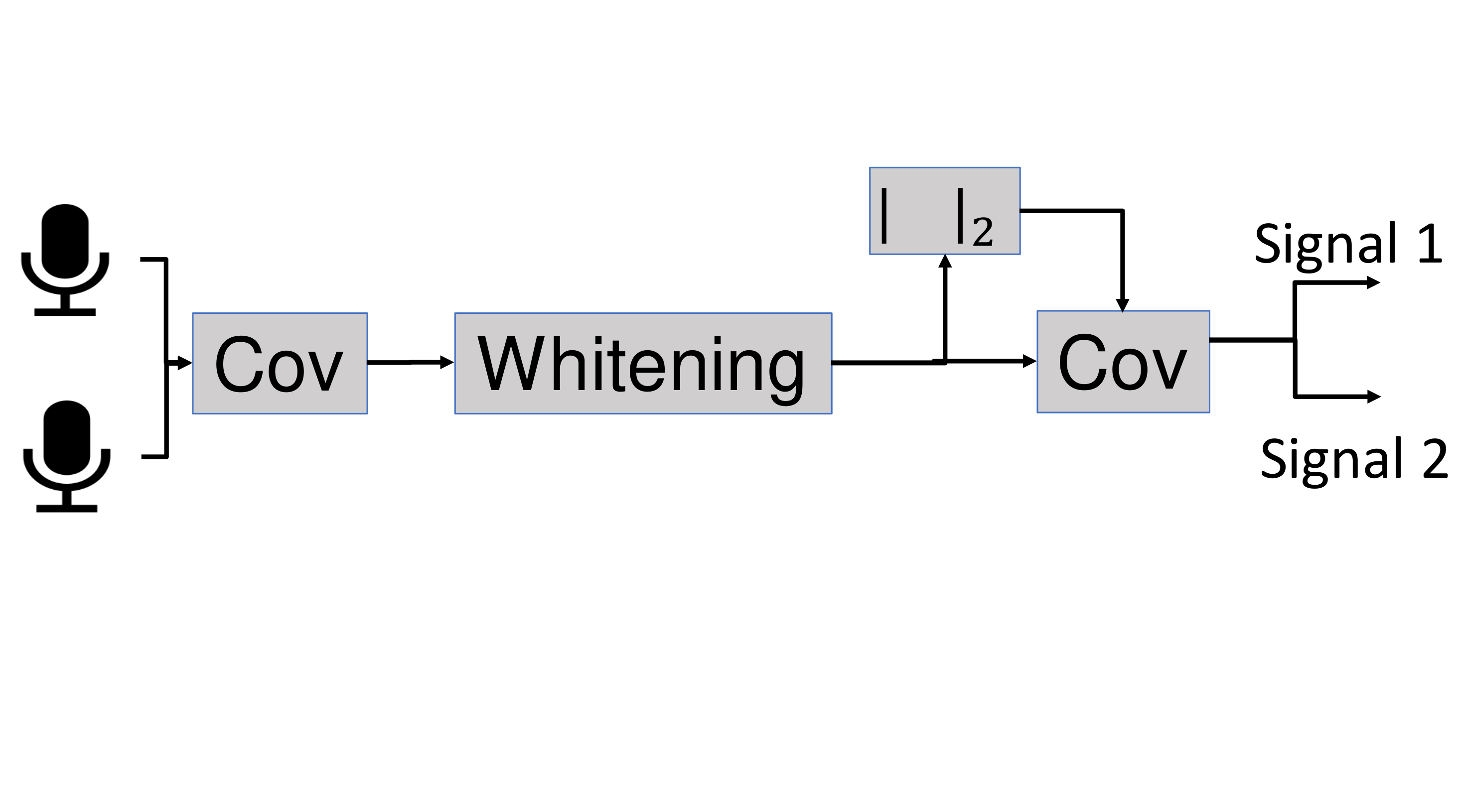 Source Separation
The current implementation uses instead of microphone wav-files to get the acoustic signals. Our implementation also measures the network delay, CPU utilization, etc, using LoggingJob and LoggingSinkJob.
For more information on the implementation, take a look at the documentation.
Synchronization
In WASN, the microphones have their own sampling clock, however, missynchronization between microphones will de-grade the performance of acoustic applications. We consider Double-cross-Correlation Processor (DXCP) [2] for estimating the sampling rate offset between different microphones, which can then be used to adjust the sampling clock [3] or to compensate for their missynchronization in further acousticprocessing. DXCP applies only under the assumption that sampling rate offset is time-invariant.The DXCP application can be divided into two main tasks: cross-correlation function and parabolic interpolation. The former is used to estimate the accumulated time delay between two (time-framed) signals. The output is then forwarded to the latter that uses a second-order polynomial interpolation to find the maximum lag and estimate the sampling rate offset. The overlay graph can be seen in the following figure.
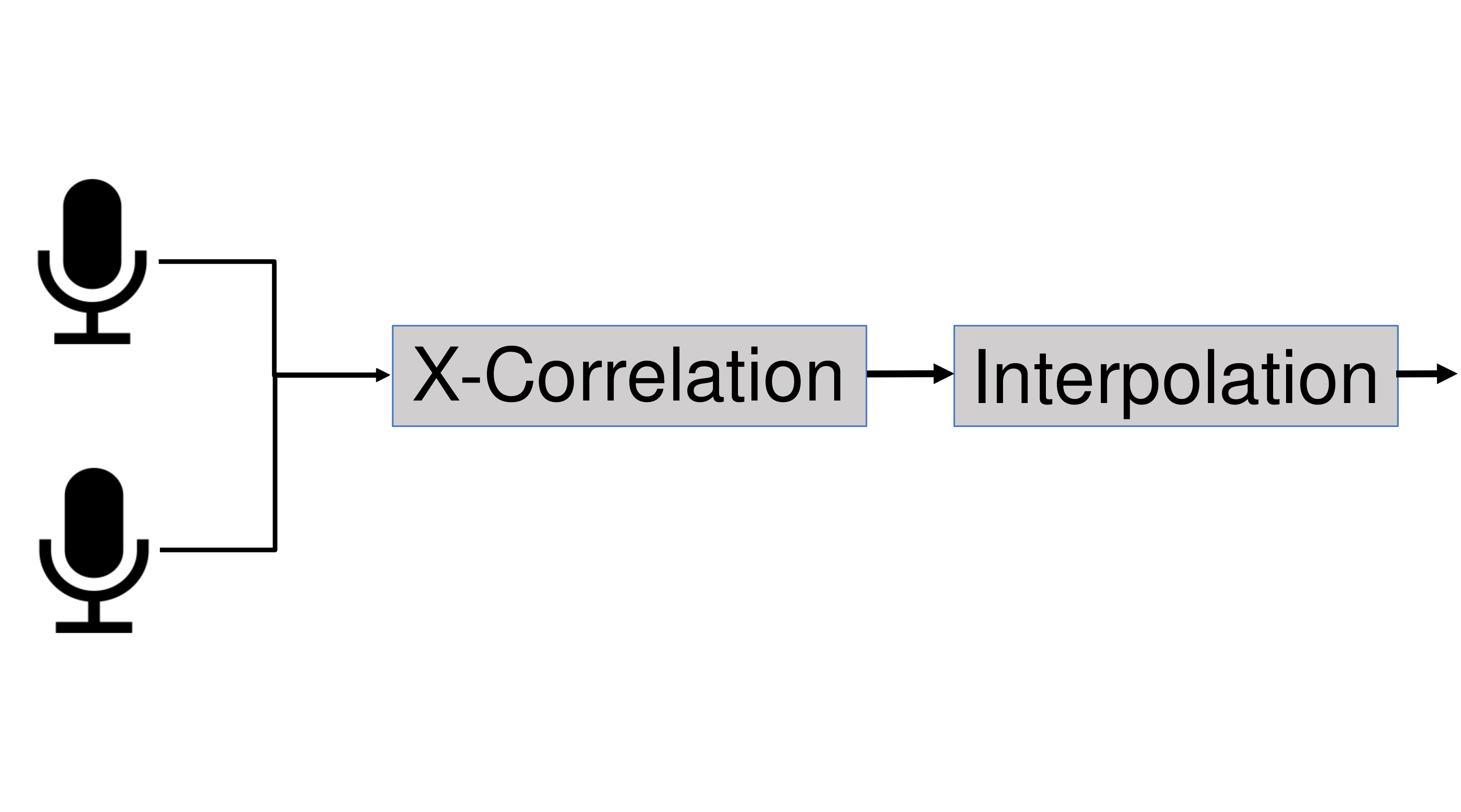 DXCP
DXCP
The current implementation uses instead of microphone wav-files to get the acoustic signals. Our implementation also measures the network delay, CPU utilization, etc, using LoggingJob and LoggingSinkJob.
For more information on the implementation, take a look at the documentation.
Literature
[1]: J. Cardoso, “Source separation using higher order moments,” in International Conference on Acoustics, Speech, and Signal Processing, 1989, pp. 2109–2112 vol.4.
[2]: A. Chinaev, P.Thüne, and G. Enzner, “A double-cross-correlationprocessor for blind sampling rate offset estimation in acoustic sensornetworks,” in Proc. IEEE Int. Conf. Acoust., Speech, Signal Process., May 2019, pp. 641–645.
[3]: A. H., S. J., U. J., H.-U. R., and K. H., “MARVELO – a framework for signal processing in wireless acoustic sensor networks,” 13th ITG conference on Speech Communication, October 2018.